From signup to your first billed frame in about ten minutes.
This walkthrough takes you from an empty account to a paid session: register, run the setup wizard, open the floor, start a session on a table, record a frame, and check out. Each step links to the full guide if you want more detail.
1
Create your account
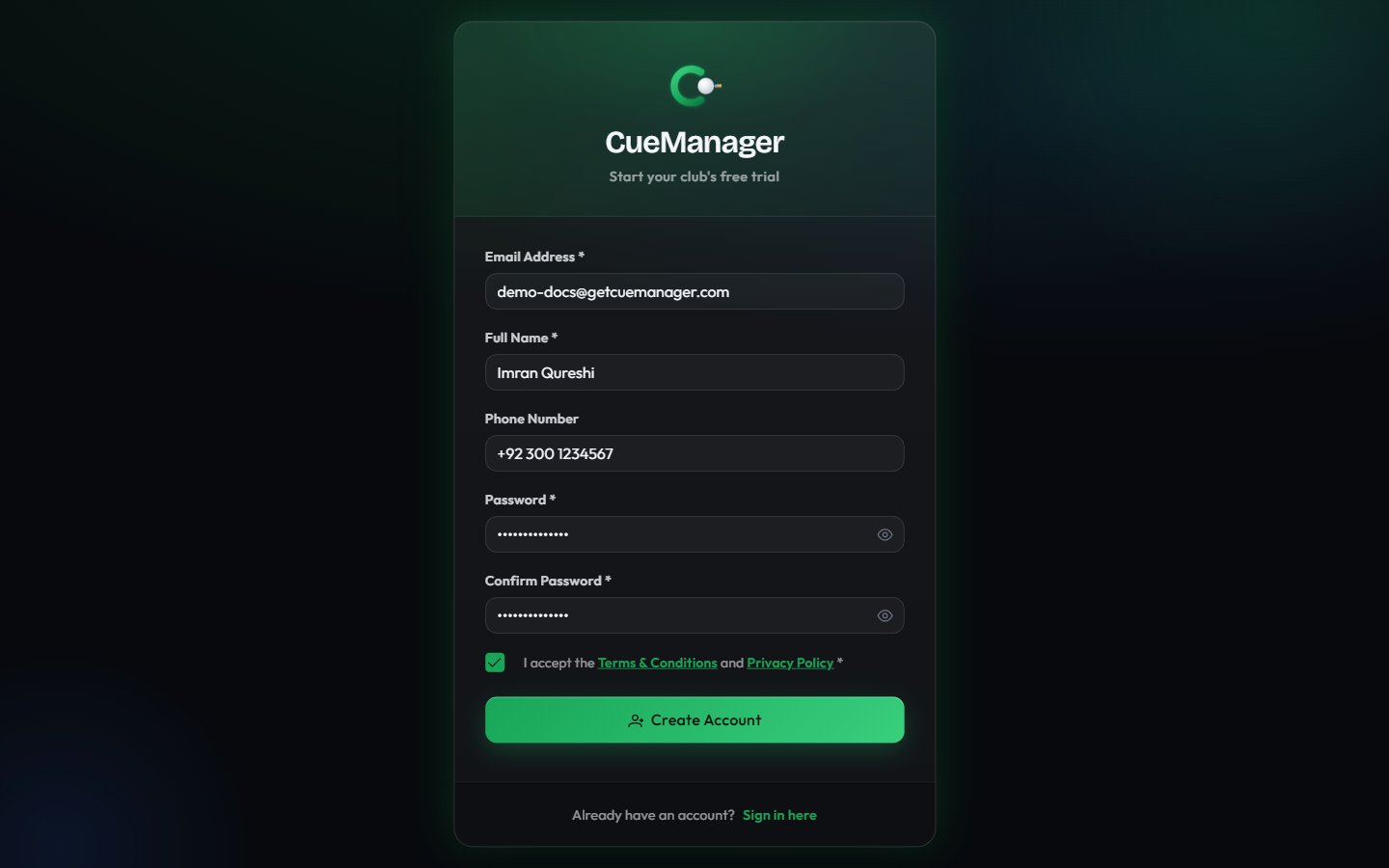
Go to the registration page and fill in Email Address, Full Name, Password (at least 6 characters), and Confirm Password. Phone Number is optional. Tick I accept the Terms & Conditions and Privacy Policy, then choose Create Account.CueManager emails you a verification link that is valid for 24 hours. Click it, and you land straight in the setup wizard.
Registration creates the owner account for your club
Full details, including resending the email and resetting a password: create your club.
2
Complete the setup wizard
The wizard runs six steps: Organization (club name, contact details, currency), Subscription (start a 14-day trial), Branch (name, code, and your table rates), Tables (how many snooker and pool tables to create), Team (optional staff accounts), and Complete.For a club like Crown Snooker Club in Lahore, choose Pakistani Rupee as the currency, name the branch “Gulberg Branch”, set Rate per Frame to 500, and create four snooker and two pool tables. That gives you Snooker 1-4 and Pool 1-2 on the floor.Step-by-step: set up your club.
3
Open the live floor
Choose Go to Dashboard at the end of the wizard, then View Tables (or Tables in the sidebar). Every table appears as a card with its status: Available, Occupied, Reserved, or Maintenance.The floor is live. When another device starts or ends a session, the cards update without a refresh. See the live floor.
4
Start a session
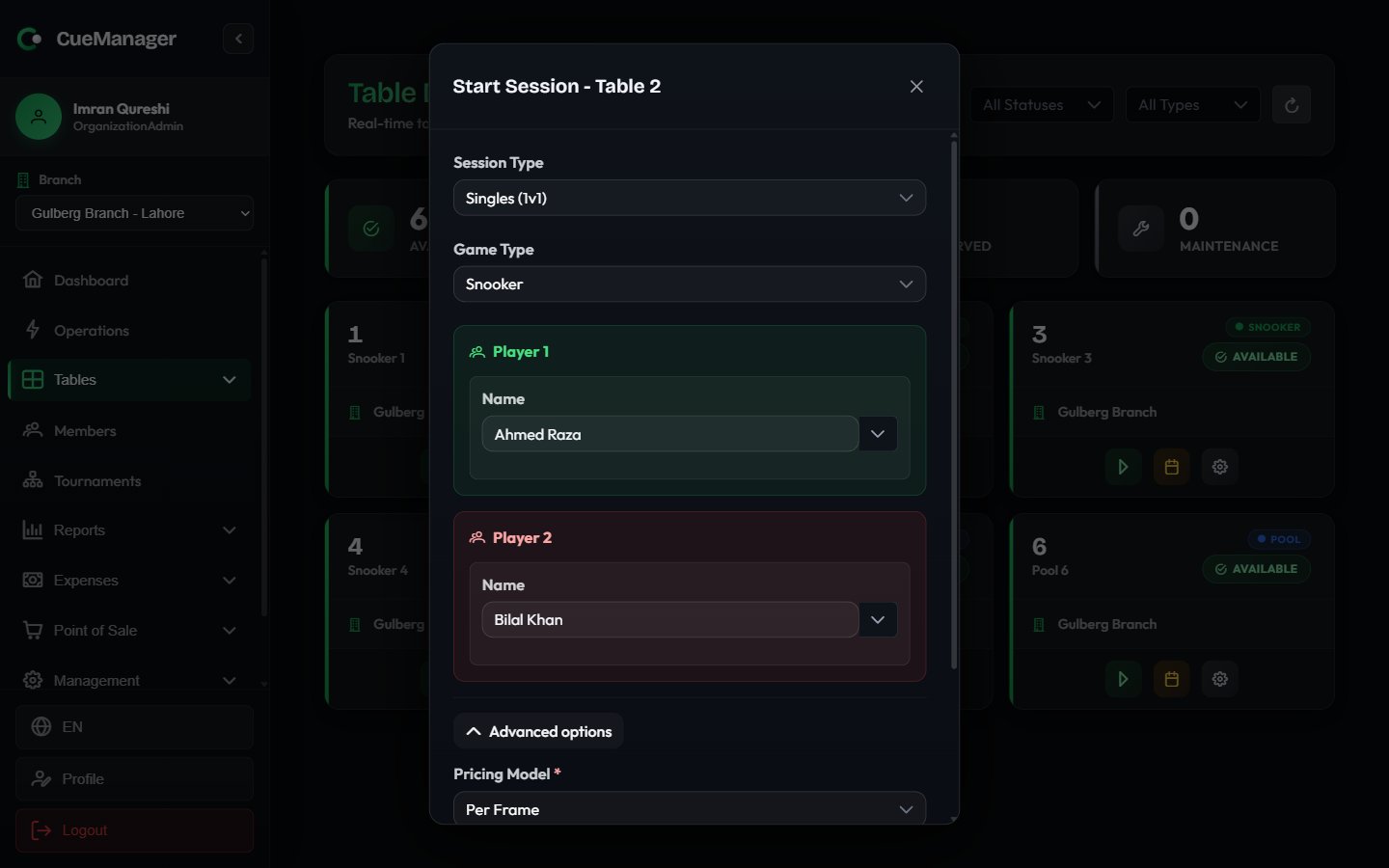
On the Snooker 1 card, choose Start Session. In the Start Session - Table Snooker 1 dialog set:
Game Type — Snooker, 8-Ball, or 9-Ball (snooker is not offered on pool tables)
Session Type — Singles, Doubles, or Practice
Player names — type a walk-in name, or search for a registered member such as Ahmed Raza
Pricing Model — Frame, Hourly, or Per minute
Billing Type — open-ended or pre-paid
Base Frame Price — pre-filled from the branch rate, for example Rs 500
For doubles, the dialog shows Doubles: Frame price will be 2x. Choose Start Session and the table flips to Occupied.
Starting a singles snooker session with frame pricing
When a frame ends, use the session panel on the table card and choose P1 Wins or P2 Wins (Team 1 Wins / Team 2 Wins in doubles). The frame count and the running total update immediately on every device.In frame pricing, the loser of the frame is charged for it, so recording the winner is what drives the bill. For ball-by-ball scoring with pots, fouls, and a public spectator scoreboard, choose Open marker instead — see the snooker marker.
6
Check out
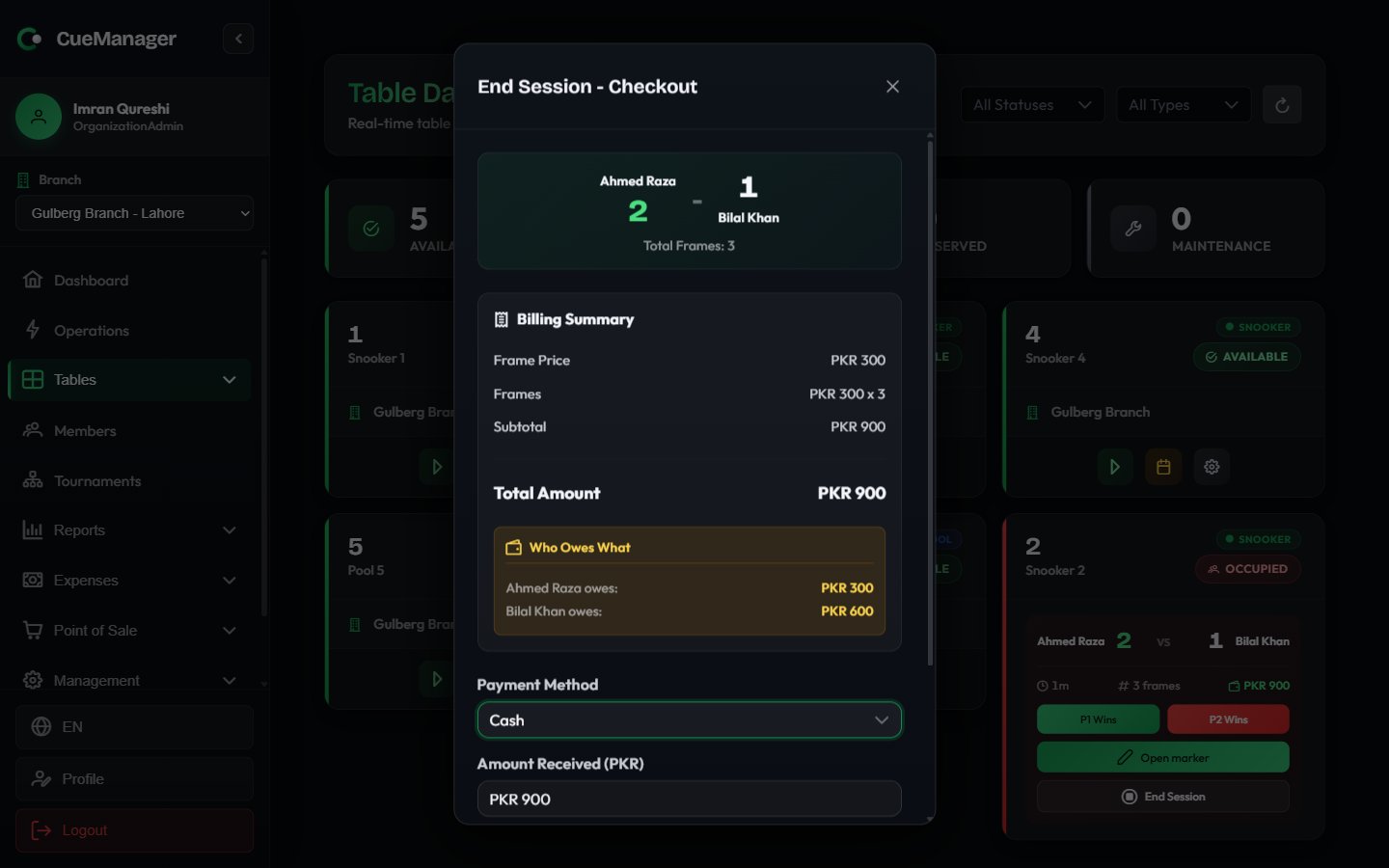
Choose End Session to open End Session - Checkout. The dialog itemizes frames or table time, applies any member discount, adds POS charges, and shows Who Owes What per player.Pick a Payment Method — Cash, Card, JazzCash, Easypaisa, Raast, bank transfer, or a member’s wallet credit — enter Amount Received, and choose Complete Payment. If the players want to pay later, choose Add to Tab instead and settle the tab at the end of the night.
Checkout splits the bill per player and accepts multiple payment methods